
Hiring the Right Salesperson – Part 3

Posted in Career Search Tools & Education, Improve Sales & Profits, Leadership Development & Training, Performance Management, Talent Development & Training on Oct 13,2026
This is the third of four installments of an article on how to select the right salesperson. These same strategies and tactics could be applied equally to hiring ANY position in any industry. In How to Hire the RIGHT Sales Talent Part 2 and Part 1 we answered four important questions:
- What are the top four mistakes made when hiring salespeople?
- What is the actual cost of making a poor hiring decision?
- What are the essentials of planning you must get right at the start of the hiring process?
- What are the top job-specific factors that must be considered when hiring?
In Part 3 of Hiring the RIGHT Salesperson, we’ll explore the answers to three more provocative questions.
Question 5: When Considering a Candidate, What are the Best Predictors of Success?
This is a critical question that deserves consideration. It costs a great deal to hire someone and even more if they don’t last long enough to pay for themselves. Look at the success factor balloons below. All of the factors are important considerations when evaluating a sales candidate. Which success factor (or factors) is (are) the best predictor(s) of a salesperson’s success?
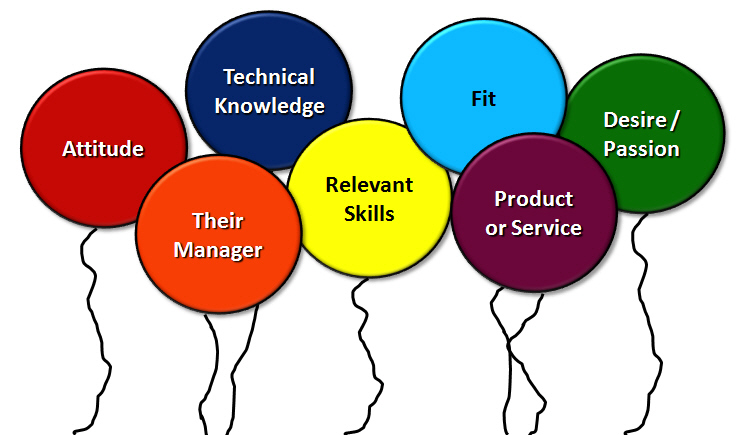
To more fully understand the answer, organizations such as McKinsey and Leadership IQ have studied success factors correlated with a salesperson’s productivity and longevity on the job. Attitude is important, but there are people with terrific attitudes that don’t sell effectively. While people may stay at or leave a job because of their manager (see Gallup-backed research here), their degree of success is not determined by their manager. A person’s technical skills give them an advantage when it comes to understanding a complex or technical product or service while knowing the relevant skills to do the job is important, but neither is predictive of success. The type of product or service being sold has little bearing on individual success.
The two factors that were most predictive of someone’s success once hired were fit (1) and desire/passion (2):
- Fit. There were two aspects of fit that when considered together made fit the Number 1 predictor of success. Organizational fit is how well the person fits the values and culture of the organization. In other words, the person seems to be “one of us” in his or her work habits, personal values, ways of working within the organization, and other similar factors. People fit is how well the person relates to and interacts with his or her coworkers and customers. People fit has a great deal to do with different behavioral styles and how well they complement one another.
- Desire & Passion. Every job has its challenges. Desire and passion speak to an individual’s drive, willingness, and energy to work through obstacles and challenges. Will he or she do what it takes to be successful, regardless of the point from which he or she starts?
Question 6: What Factors Must be Considered in Order to Get Sales Compensation Right?
As discussed in Part 1 of Hiring the RIGHT Salesperson, a sales compensation plan must motivate and drive behaviors that are good for their employer. Not all revenue has the same value, so compensation plans should reward high-value revenue more, and low-value revenue less. Other considerations include:
- Establish the right mix of fixed and variable (performance-based) compensation for your organization. Base (or guaranteed) income must be enough to attract and retain qualified sales staff. Variable compensation is at-risk and performance-based , and should keep sales staff focused on profitable, long-term revenue generation.
- Do your compensation research. Sites like payscale.com, salary.com, and Glassdoor.com provide you with market-based compensation data adjusted by location. This information will help you establish a compensation plan that is competitive and adjusted for the specific location where the sales position is based.
- Base your base compensation on what each individual brings to the job. Each candidate possesses qualities and experience levels that make them more or less attractive to your organization. Base compensation – within reason – should reflect what a candidate brings to you.
- Publish your sales compensation plan, but with the ability to change it from time to time. By publishing your comp plan, your sales staff can refer to it. They will use it to figure hot what to do to maximize their income. Sales compensation plans aren’t static because your solutions aren’t static, nor is the marketplace. So include a statement such as, this compensation plan is effective {date} and is subject to change from time to time with or without notice.
- Make certain your comp plan is simple to understand and calculate. When comp plans are complex, they are less effective in driving behaviors and results.
- Pay for net results, not activity. While there is a connection between activity and results, compensation plans should pay only for the actual net sales results that are delivered.
Question 7: Are There Different Factors to Consider When Adding Sales Staff, Versus Hiring a Solo Performer?
As was discussed in Question 5, fit with your culture and with your team is the best predictor of success. One way to measure this likelihood of fit is through the use of a behavioral profile such as DISC:
- Assess team fit. Each team of people has a culture that is defined by the collective behavioral makeup of the team’s members. You can compare a sales candidate’s profile to that of the team to see how the candidate will complement (or be in conflict) with the team.
- Assess ability to work as a solo performer. Use the behavioral profile to determine whether or not a sales candidate has the makeup to work as a solo performer.
- Assess customer fit. If assigning an account base, a behavioral profile can provide insight into how the salesperson will interact with his or her customers.
Candidates for solo roles perform better if they possess a generalist set of skills. Generalist skills allow salespeople to relate to most/all of the prospects and customers they are likely to serve. Conversely, if adding to an existing staff, prefer candidates with specialist skills, especially specialist skills not possessed by your existing sales staff.
There is a special DISC assessment for sales and customer-facing roles that reveals a candidate’s selling behaviors, and we recommend it whenever hiring sales talent.
Bottom Line
So far we’ve dealt with seven questions that must be answered if you want to make consistently good hiring decisions:
- What are the top four mistakes made when hiring salespeople?
- What is the actual cost of making a poor hiring decision?
- What are the essentials of planning you must get right at the start of the hiring process?
- What are the top job-specific factors that must be considered when hiring?
- What are the best predictors of success when considering a candidate?
- What factors must be considered in order to get sales compensation right?
- Are there distinct factors to be considered when adding to the sales staff, versus hiring a solo performer?
In the last installment of Hiring the RIGHT Salesperson we’ll explore such topics as which hiring decision factors to consider when selecting a candidate, and what should be included in an effective onboarding program.
The preceding was created from our webinar, Hiring the Right Salesperson, which is part of Boyer Management Group’s B2B Sales Essentials™ program, named a Top Sales Training Program for multiple years.
About me: Since founding Boyer Management Group 26 years ago, I’ve been blessed to work with some of the world’s top employers by helping them get the most out of their talented people. Thanks to our clients, the company I founded in 1998, Boyer Management Group, was recognized by CEO Monthly Magazine in 2023 and again in 2024, awarding us their “Most Influential CEO Award” in the executive coaching field. Our coaching programs produce remarkable results in compressed periods of time. Our extensive leadership development course catalog provides effective skills-building for everyone in the organization, from the new and developing leader to the seasoned C-level executive. BMG boasts one of the most extensive sales and sales management curriculums anywhere, with behavioral assessments to help develop talent. To find out more, please visit us at www.boyermanagement.com, email us at info@boyermanagement.com, or call us at 215-942-0982.


Latest Leadership Posts
Effective People Live the Goldilocks Principles Continue Reading
Don’t Be That Guy Continue Reading
How to Hire the RIGHT Sales Talent – Part 1 Continue Reading

