
Give Your Development Plan Transforming Power

Posted in Assessments & Evaluations, Career Search Tools & Education, Dynamic Training News, Latest Leadership Posts, Leadership Development & Training, Performance Management, Talent Development & Training on Feb 17,2026
Over my fifty-year career I’ve taught, coached and mentored more than 20,000 people on how to improve their habits and skill sets, in order to optimize their career effectiveness and growth. Many of those people today occupy senior level positions across the globe in some of the world’s most admired organizations.
This is the second of a three-part series on how to get better at anything. Part 1 proposed a format that will help you build an actionable self-improvement plan, while Part 2 will explain the science behind making action plans transformative. Part 3 will provide you with the specifics of transforming your action plan into new habits.
It has been my experience that over the course of one year of using the approaches outlined in this three-part series, you can learn and master two to four dozen new behaviors and turn them into habits.
You may want to read and re-read Part 1 of this post before reading this Part 2. Part 2 will focus on some of the science behind how to engage your mind to accelerate the incorporation of new and effective habits that will produce more desirable outcomes.
The Power of Visualization
Few people embody the power of visualization better than Tom Brady, a seven-time NFL Super Bowl world champion. Lest we forget, he was a mediocre college player who wasn’t drafted by the New England Patriots until late in the sixth round of the NFL college-player draft, chosen 199th. That means that every other football team rejected him five or six times before the Patriots selected him. The best football minds in the world deemed him “not good enough.” Yet he played at an exceptional level for 23 seasons and is the all-time NFL leader in passing yards (89,214), touchdowns (649), regular season wins (251), Pro Bowls (15) and a dozen more equally impressive achievements.

According to Google AI, Tom Brady’s success stems from a combination of factors including his exceptional work ethic, intelligence, and dedication to preparation, along with natural talent and a unique ability to process information quickly and accurately on the field. He was known for his meticulous approach to the game, constantly seeking ways to improve and minimize mistakes.
How did Brady process information quickly and accurately like no one else before him? He energized his work ethic, intelligence, and dedication to preparation by using visualization. Visualization is the process of forming mental images or representations, often used to imagine desired outcomes, enhance performance, or understand complex information. In simple terms, he played every game multiple times in his mind before he ever set foot on the field to play the game.
Because of repeatedly visualizing the game in his head, by the time Brady played in the real game, things had slowed down for him. This enabled him to make play after play at will in rapid successions, without mentally seizing up from the pressure to perform.
The Power of Your Subconscious Mind
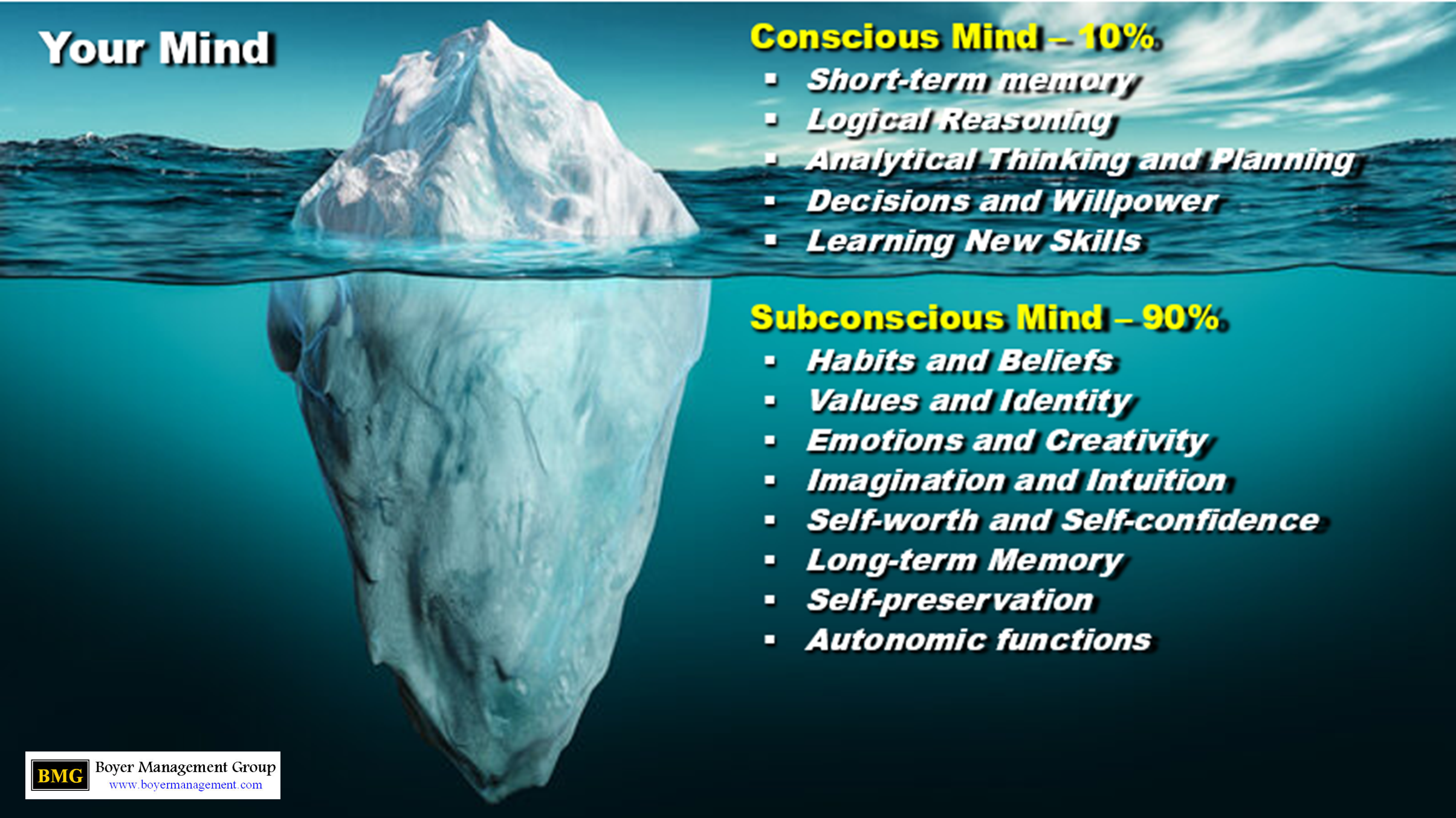
According to experts, the human mind has two parts:
- The conscious mind, which constitutes approximately 10% of brain function, is responsible for analytical thinking, rationalizing, decision-making, planning, willpower, and short-term memory. Your conscious mind cannot change itself; that requires your subconscious mind to program your conscious mind.
- The subconscious mind (about 90% of brain function) houses the autonomic nervous system (keeps your heart beating, breathing functions, and the like), your beliefs, emotions and feelings, and your long-term memory PLUS your habit and behavior patterns, creativity, imagination, and intuition.
The subconscious mind is the more powerful of the two. The subconscious mind is in control because it processes most of the information about what goes on around you. It never turns off; it is always on, even when you sleep, processing away.
The conscious mind deals with your recently learned information. Plus, it also analyses, thinks and plans, and it selects what you concentrate on. For example: While concentrating on writing this paragraph, I’m just vaguely aware of the foot traffic in front of the building, whether the heat or air conditioning is running, or how the keys on the keyboard feel to my touch.
Typically, our conscious mind can only process about seven chunks of information at the same time. That’s why (in Part 1) we intentionally selected just four to six action plan behaviors on which to focus and highlighted them in yellow to stand out and catch our eye. These are the four to six behaviors that we want to change, replace, or improve, based on our current situation and the people with whom we interact.
Yet, like Tom Brady, it will take your commitment and dedication to create your Six-Box Action Plan™ and work it work it diligently day-by-day for 60 days.
Author Brian Tracey writes in his article, Subconscious Mind Power Explained, about the forces at work that resist the changes you want to make: You can feel your subconscious pulling you back toward your comfort zone each time you try something new. Even thinking about doing something different from what you’re accustomed to will make you feel tense and uneasy.
This is why forming new habits that will help you reach your goals, such as following time management tips, may be tougher to implement at first, but once they become habit or routine they will stay in your comfort zone. In doing so, you’ve reprogrammed your subconscious to work in your favor.
Engage the Power of Lock-On, Lock-Out
Ever notice how easily you get distracted, especially with a world of different stimuli competing for your attention? Noises, motion, sensations, random thoughts all steadily bombard your brain attempting to arrest your attention.
Yet there are times when you are in high-concentration mode, and your mind has the ability to selectively focus on one or a few items and selectively ignore all other thoughts. This is called lock-on, lock-out. You lock onto something you desire while at the same time locking out of other things.
While this may occur naturally because of an urgent need to focus, with practice one can learn to engage lock-on, lock-out at will by simply willing it to be so. You ask your subconscious to engage lock-on, lock-out and over time it will learn the habit of engaging lock-on, lock-out when desired.
Neuro-Linguistic Programming (NLP)
Neuro-Linguistic Programming (NLP) is a psychological approach that explores the connection between our thoughts, our language, and our behavior. NLP helps us to better understand how these three elements can be used to modify and influence our behaviors, and how we can change them to achieve better and more effective habits.
NLP provides a tools and techniques framework to reprogram our mental “software” for intentional and self-directed personal growth. This, in turn, helps us to achieve a more impactful and satisfying life and career.
We will use NLP to intentionally place specific behaviors from your Six-Box Action Plan™ into your subconscious mind to create new habits.
Here are a few resources that can help you learn more about NLP and its use in self-development:
- Vanessa Van Edwards, Science of People What is Neurolinguistic Programming and is it Real?
- Sanjana Benny, Bluehost What is Neurolinguistic Programming and its Benefits?
- Lix Burton-Hughes, High Speed Training Neurolinguistic Programming: A Beginner’s Guide
In Part 3 of this series we will take the highlighted actions from your Six-Box Action Plan™ (Part 1) and combine them with the mental sciences and processes of Part 2 to create a series of sixty-day programs to transform your ineffective behaviors into effective habits.
Bottom Line
The human mind is an incredibly powerful machine that can drive transformative development. We must understand how visualization, the subconscious mind, and neurolinguistic programming can combine to accelerate and transform self-development. By utilizing proven techniques within an action plan framework, people are able to replace ineffective behaviors with effective ones, which in turn create habits for improve performance and outcomes.
About me: Since founding Boyer Management Group 28 years ago, I’ve been blessed to work with some of the world’s top employers by helping them get the most out of their talented people. Thanks to our clients, the company I founded in 1998, Boyer Management Group, was recognized by CEO Monthly Magazine in 2023, 2024, and again in 2025, awarding us their “Most Influential CEO Award” in the executive coaching field. C-Suite Insider named me its 2024 CEO of the Year for Executive Coaching. Our coaching programs produce remarkable results in compressed periods of time. Our extensive leadership development course catalog provides effective skills-building for everyone in the organization, from the new and developing leader to the seasoned C-level executive. BMG boasts one of the most extensive sales and sales management curriculums anywhere, with behavioral assessments to help develop talent. To find out more, please visit us at www.boyermanagement.com or email us at info@boyermanagement.com.


Latest Leadership Posts
Effective People Live the Goldilocks Principles Continue Reading
Don’t Be That Guy Continue Reading
How to Hire the RIGHT Sales Talent – Part 1 Continue Reading

