
The World’s Most Powerful Self-Development Tool

Posted in Assessments & Evaluations, Career Search Tools & Education, Dynamic Training News, Latest Leadership Posts, Leadership Development & Training, Performance Management, Talent Development & Training on Feb 17,2026
This is the first of a three-part series on how to get better at anything. Part 1 will feature a format that will help you build an actionable improvement or development plan, while Part 2 will explain the science behind making action plans transformative. Part 3 will provide you with the specifics of transforming your action plan into new habits.
The Self-Help Tsunami
Estimates suggest that more than a million self-help and self-development books and videos are published globally each year. The self-help category is one of the largest non-fiction categories, and it is growing rapidly. Why? Because people want the benefits that improvement in areas of need or interest will bring.
You’re probably reading this post because you want to improve the way you currently plan to improve!
You will likely find lots of innovative ideas and guidance in those million-plus books and videos, although you’ll quickly realize that a promising idea does not translate into improved performance by itself. That takes time and effort which will likely not yield immediate results. It also takes discipline to stick with it. Thus, many start well but give up before completing their objectives. Case-in-point: how quickly did you cast aside your most recent New Years’ resolutions?
How People Improve
There is a simple explanation why many people struggle to see lasting change as a result of implementing a self-improvement plan. Self-improvement plans often focus on the wrong things, such as different outcomes than what you are currently experiencing. You want different outcomes, but the outcome in itself is not an action plan.
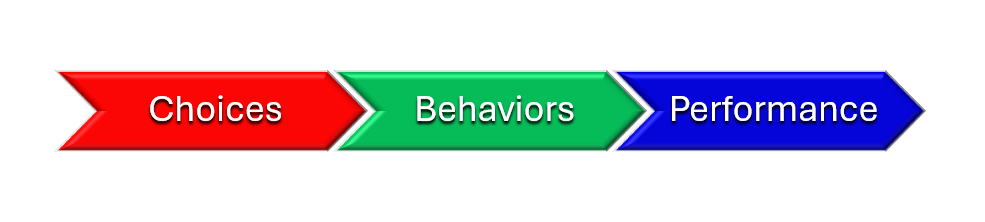
How does improvement work? Improvement starts with a choice to improve. You and I need a reason we want to improve, or learn something, or master something. Without a compelling reason to improve, it is likely that we will simply fall into old habits where nothing really changes.
The fundamental secret of making an action plan succeed is to focus on behaviors because behaviors drive outcomes. That’s why we need to implement a combination of new or improved behaviors while eliminating or reducing our current less-effective behaviors. Habits are simply our go-to behaviors, often done without thinking.
Thus, our choices drive our behaviors, and our behaviors drive our performance. If you want to change your performance or outcomes, you must change your behaviors.
Changing Behaviors Requires Changing Habits
If you are going to make the choice to change behavior, you must be aware of your own tendencies and habits. Webster’s Dictionary defines habit as an acquired mode of behavior that has become nearly or completely involuntary. Habits started as a choice that got repeated enough to become nearly or completely involuntary. That’s fantastic when the behavior is effective, but annoying when the behavior is ineffective or inappropriate.
Here are three persistent truths about habits:
- Experts suggest that it takes 21 days to create a new habit where nothing exists.
- It takes 45 days to replace an ineffective habit with an effective habit.
- Acquiring or changing a habit is challenging work.
Thus, an optimal time period to focus your efforts on changing behaviors is 60 days, long enough to lose less-effective habits and replace them with new, more effective habits.
Introducing the World’s Most Powerful Self-Development Tool
I’ve spent the better part of my career developing people. With 24 years in the corporate world and 27 more years in my own talent-development company, I’ve had a lot of practice changing behaviors, both my own behaviors and those of thousands of other people.
This Six-Box Action Plan™ format below has accelerated the development of people across all industries sectors and with people at every level of responsibility, from individual performers to C-level executives. It is perfect for self-development, with or without a coach. The Six-Box Action Plan™ is the tool, I’ll provide you with the methodology, and you’ll add the commitment and follow-through.
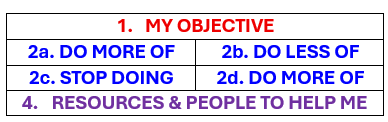
Here’s what goes into each of the six boxes:
- Box 1: My objectives for addressing this area is (are), and why this is important to me. A crucial consideration is for you to identify why you want to improve your leadership skills in this area. The most important reasons are the ones that will energize your commitment to working your action plan. Hence, a good objective statement might read, “I want to improve in (the specific area) because if I do, it will benefit me and others by (list the benefits).”
- Box 2a. Things I should do more of or continue doing. In the context of your specific situation and people with whom you will be interacting, these are your current behaviors that doing more of (or continuing to do) will help you achieve your objectives (Box 1).
- Box 2b. Things I should do less of. In the context of your specific situation and people with whom you will be interacting, these are your current habits that are less effective in helping you to achieve your objectives (Box 1).
- Box 2c. Things I should stop doing. In the context of your specific situation and people with whom you will be interacting, these behaviors or habits are detrimental to achieving your objectives, so you must eliminate them.
- Box 2d. Things I should start doing. In the context of your specific situation and people with whom you will be interacting, these are new behaviors you want to implement to become regular habits.
- Box 3: The Resources and People I can Call Upon to Help Me Achieve My Objective. Resources could include areas of improvement from an assessment, such as the TriMetrix EQ; suggested actions to take from self-help and how-to books, articles, and websites; and feedback from supervisors, including performance evaluations. People include your supervisor, coach, mentor, subject matter experts, and others who have an interest in your growth and development.
Experience in collaborating with people using this tool suggests that no fewer than four entries should be made in each of the boxes 2a-2d, with no more than eight entries in any of boxes 2a-2d.
It is likely that it will take you several drafts to create and refine your initial Six-Box Action Plan™ before you can fully implement it.
In our next installment of this series, we’ll discuss how to take a well-written Six-Box Action Plan™, put it to work, and make it transformative.
Bottom Line
Achieving improvement is demanding work. You must first overcome both your reluctance to change as well as the persistent habits which govern the way you do things. Improvement comes when you focus on behaviors, not performance (performance happens as a result of behaviors). Most of all, achieving improvement is just a wish, until you create a plan and then work that plan. The Six-Box Action Plan™ format has produced astounding results for those who have implemented it.
About me: Since founding Boyer Management Group 27 years ago, I’ve been blessed to work with some of the world’s top employers by helping them get the most out of their talented people. Thanks to our clients, the company I founded in 1998, Boyer Management Group, was recognized by CEO Monthly Magazine in 2023, 2024, and again in 2025, awarding us their “Most Influential CEO Award” in the executive coaching field. C-Suite Insider named me its 2024 CEO of the Year for Executive Coaching. Our coaching programs produce remarkable results in compressed periods of time. Our extensive leadership development course catalog provides effective skills-building for everyone in the organization, from the new and developing leader to the seasoned C-level executive. BMG boasts one of the most extensive sales and sales management curriculums anywhere, with behavioral assessments to help develop talent. To find out more, please visit us at www.boyermanagement.com or email us at info@boyermanagement.com.


Latest Leadership Posts
Effective People Live the Goldilocks Principles Continue Reading
Don’t Be That Guy Continue Reading
How to Hire the RIGHT Sales Talent – Part 1 Continue Reading

