
Training Programs are a Bad Investment Unless… Part 2

Posted in Career Search Tools & Education, Dynamic Training News, Latest Leadership Posts, Leadership Development & Training, Performance Management, Talent Development & Training on Jun 23,2026
In the Part 1 of Training Programs are a Bad Investment Unless… we explored how some training programs fail to achieve an acceptable return on investment, in light of the fact that on average, organizations spent nearly $1,300 last year to train each employee. Read Part 1 to better understand these key points:
- The correlation between training and development, employee engagement, and employee retention.
- The steps effective managers can take prior to a training event in order to assure that participants are explorers, and not vacationers or prisoners.
- The actions effective managers take during training programs to monitor the quality of learning occurring in each session
Want further proof that investing in employee development produces a ridiculously high ROI? Consider this LinkedIn Workplace Training Report that stated 94% of employees who quite their job would have stayed longer had their employers invested in their training and development. The replacement costs for hiring new employees exceeding half the annual fully loaded employee cost, employers would have saved millions or billions of dollars in that time period had they provided a more robust and relevant training and development program to their people.
We’ll now explore the steps effective managers take following a training event to multiply the training program’s ROI (return on investment).
The Holistic Performance Management Model
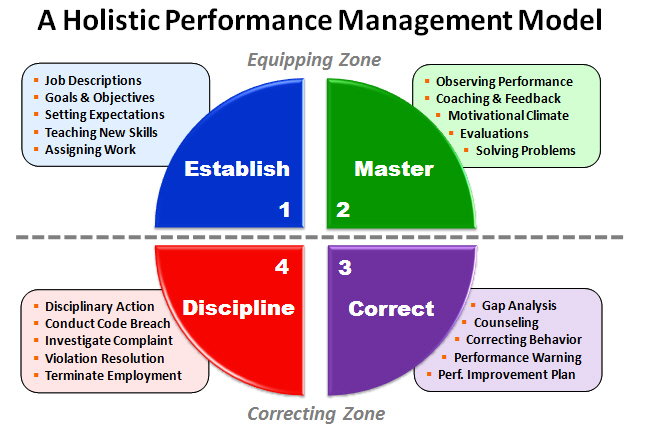
The Holistic Performance Management Model is a helpful way to visualize how effective managers manage their staff performance. Note that Quadrant One, Establish, is where you find training (Teaching New Skills). Training is just the first part of the equation. Unless employees correctly apply what they learned and practice it, they will never master it. That’s why Quadrant Two, Master, is so critical to the success of training programs and improving their ROI. What managers do here as they Observe Performance and provide Coaching & Feedback to their staff assures that the employee will master what he or she has learned and apply the learning consistently and correctly so that it becomes a habit. You can learn more about Holistic Performance Management by clicking on the link.
Effective Managers Model What Was Taught
When a manager participates fully in a training program, he or she is able to apply and model what was taught through his or her actions. For example, suppose the training topic – improving interpersonal communications – presented ways that good communicators ask questions and use interactive listening to engage with others more effectively. Following the training the manager models these behaviors and approaches by asking more questions, better questions, and using listening techniques. Not only does this result in an improved level of personal communication, but it also reinforces what was learned for the rest of the staff to benefit.
Effective Managers Intentionally Observe What Was Taught
In his management classic, The One Minute Manager, Ken Blanchard sets forth one of the most important management principles that any manager can apply daily: catch employees doing something right. In order to catch them doing something right, you need to be carefully observing what they are doing. This places you in a perfect position to help the employee polish the skills they learned in training until each is perfectly and consistently applied.
That means setting aside time on your calendar each day to observe your staff as staff members have opportunities to apply what was taught. Experience shows that if you don’t schedule time to observe performance – and then follow your schedule – the busyness of the day will overtake you and you’ll never get around to practicing this critical performance management discipline.
Effective Managers Coach What Was Taught
Coaching is not telling people what you have observed – that is giving feedback. Coaching uses questions to help an employee self-assess his or her application of new skills and knowledge in order to lead him or her through the process of self-discovery. Coaching correctly is the single most important talent development tool a manager has! Click on Basic But Brilliant Coaching Questions to learn more about this management super skill.
I suggest the use of three initial coaching questions. Each question opens up the process of self-discovery and should be followed by questions that drill down on the employee’s answers. Complete the drill down on the first question before you move to the next question, and DO NOT PROVIDE FEEDBACK until you have asked (and have gotten the answers) to each of the coaching questions. Here are the three initial coaching questions:
- In applying (the skill or knowledge), what went well for you? Ask follow-up questions until you drill down in this area.
- In applying (the skill or knowledge), what did not go as well for you as you would have liked? Ask follow-up questions until you drill down in this area.
- If you could do things over again, what would you do differently (and why/how)? Ask follow-up questions until you drill down in this area.
Effective Managers Offer Feedback on What Was Taught
Effective managers wait until they have fully coached an employee before giving feedback on what they’ve observed. Why? Because the manager cannot learn anything about what an employee knows if the manager is doing all the talking. The coaching questions help reveal what the employee knows and doesn’t know. Coupling this information with what the manager has observed, he or she is now positioned to provide specific feedback to further help the employee master what he or she was taught.
Bottom Line, Part 2
Effective managers multiply the ROI on the company’s investment in training through four intentional activities: modeling what was learned; observing the application of what was learned, then coaching, and finally providing feedback on what was learned. In this way the employee moves from learning to mastering the skill or knowledge and making it a repeatable habit.
About me: Since founding Boyer Management Group 26 years ago, I’ve been blessed to work with some of the world’s top employers by helping them get the most out of their talented people. Thanks to our clients, the company I founded in 1998, Boyer Management Group, was recognized by CEO Monthly Magazine in 2023 and again in 2024, awarding us their “Most Influential CEO Award” in the executive coaching field. Our coaching programs produce remarkable results in compressed periods of time. Our extensive leadership development course catalog provides effective skills-building for everyone in the organization, from the new and developing leader to the seasoned C-level executive. BMG boasts one of the most extensive sales and sales management curriculums anywhere, with behavioral assessments to help develop talent. To find out more, please visit us at www.boyermanagement.com, email us at info@boyermanagement.com, or call us at 215-942-0982.


Latest Leadership Posts
Effective People Live the Goldilocks Principles Continue Reading
Don’t Be That Guy Continue Reading
How to Hire the RIGHT Sales Talent – Part 1 Continue Reading

