
Better Ways to Manage Stress in 2026, Part 1

Posted in Assessments & Evaluations, Dynamic Training News, Latest Leadership Posts, Leadership Development & Training, Performance Management, Talent Development & Training on Jan 20,2026
Stress is the new epidemic sweeping the globe in all the places you live and work. While occasional and moderate stress can actually improve your life and outlook, excessive and prolonged stress can literally kill any joy you have in working and living.
In Part One of this three-part series Stress, a Worldwide Epidemic in 2026 we examined how to better understand the new world of stressors and considered several diagnostic tools to help you better understand how you (and others) manifest stress and respond to it. In Parts Two and Three we’ll investigate better ways to manage stress.
Life is Full of Stress
The American Institute of Stress offers an insightful tool to help you get a handle on your current levels of stress. It’s called The Holmes-Rahe Life Stress Inventory and it will help you identify the specific stressors in your life to arrive at a score that indicates the stress load you are under. It’s a resource I recommend you visit periodically to take stock of how much of a stress load you are under.
Here is an image of what part of the Holmes-Rahe Life Stress Inventory looks like:
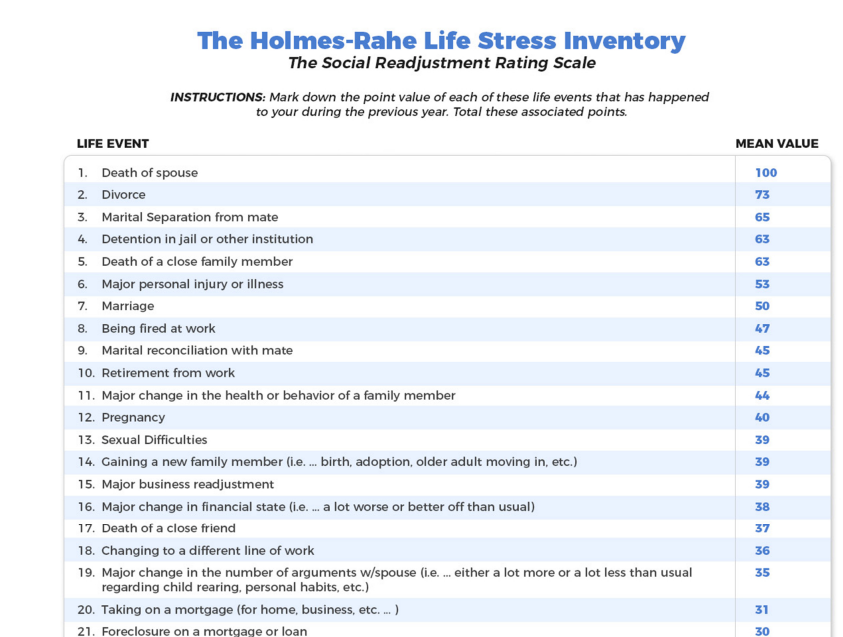
A composite score of less than 150 means a relatively low amount of life change and a low susceptibility to stress-induced health breakdown, while composite scores above 300 are dangerous to your long-term well-being. Moreover, different people handle stress differently, and some have higher or lower tolerance levels than you for the same amunt of stress.
The Four A’s to Help You Manage Your Own Stress Levels
Several leading authorities for stress management suggest an approach to manage the specific stress in your life by applying the Four A’s:
- AVOID unnecessary stress in your life;
- ALTER situations where you encounter stress;
- ACCEPT stress that you cannot avoid; and
- ADJUST how you approach the stress you must deal with.
It will most likely be a combination of stress management techniques that will help you manage your stressful times. And you’ll invariably identify your best go-to strategies. Most importantly, you’ll be able to see a clearer path through your stressful times.
AVOID the Unnecessary Stresses In Your Life
Some stress in life is unaviodable. Such as having to travel unexpectedly in response to a family crisis. Or finding yourself facing a natural disaster that arises without warning. Or having your employment situation dramatically change without notice. That said, here are some best practices to help you avoid unnecessary stress:
- Know What Stresses You Out. In Part 1 of this series we considered how assessments can help identify your stress behaiors and triggers. We also viewed The Holmes-Rahe Life Stress Inventory. Certain people tend to stress you, too much caffeine tends to stress you, watching certain streaming entertainment stresses you… so take an inventory of the things, people, events, etc. that stress you. Make it a point to avoid or reduce those you can control.
- Avoid Known Stressors. It’s not that hard to do. As an example, there was someone who kept the same exercise schedule that I do, who took great delight in finding something to argue about. When I realized I was letting this happen, I decided to change my schedule and simply not engage with him. That ended my getting stressed out by him. When I kept encountering stress-inducing traffic I found an alternative route that was less stessful.
- Avoid Extremes. There’s much to be said in favor of moderation. Too much of a good thing isn’t good anymore. True of Diet Coke, ice cream, and hundreds of other things. Did you include the things in which you over-indulge in your list of stressors? Moderation means you are in control…
- Learn to Say NO. Some people feel guilty when they say “no.” When someone knows this about you, they’ll guilt you into adding things that will oversubscribe you and stress you out. Set your limit and stick to it. Learn to say no in both your personal and professional life.
- Put Your Own To-Do List on a Diet. Related to #4 above. Identify the Must-Do’s (your life or job depends on these) and the Wanna/Should/But-Don’t-Need-to-Do’s. Be ruthless about purging anything that not a Must-Do.
- It’s YOUR Space. Does certain programming raise your blood pressure? Like the nightly news? Turn it off and find something that you can enjoy. Do crowded places make you aprehensive? Don’t go there. Hate when all the commuters decide to turn your route to work ito a parking lot? Choose a different route, time, or method of transportation… negotiate work-from-home times. Loud raucous sounds unnerve you? Stop listening to head-banging music… try smooth jazz instead.
- Maintain a healthy lifestyle. The usually revolves around the BIG THREE of diet, exercise and sleep. Make the changes you need to make. Such as turning off devices and going to sleep at an earlier hour. Like getting up early and getting a walk or workout in first-thing. Like choosing a healthy diet over one that makes you stressed, slow and sluggish. Punt the nasty habits that keep you feeling less than on top of your game. It’s YOUR lifestyle… ensure your lifestyle is helping you and not stressing you.
ALTER the Situations Where You Encounter Stress.
You will be amazed at the things you can do to lower stress levels when stress is a part of life or work. This often means changing the way you approach situations and people, how you communicate, or how you work through stressful situations.
- Stop trying to eat whole elephants. One of the most common ways we stress ourselves out is to overreact when we encounter a big and complex objective, task, or situation (aka whole elephants). The only way to eat an elephant is one forkful at a time. So take that whole elephant objective, task, or stuation and break it down into tiny pieces, then eat one piece at a time. Less stress that allowing yourself to be overwhelmed by the whole elephant.
- Express yourself. I grew up in a family that rarely talked about how things made us feel. We learned to keep things bottled up inside, and unfortunately that is a prime driver of stress. Do this over and over again and the pressure will eventually burst the bottle… It is so much better to express houw you feel – calmly, respectfully, non-accusatorily – and talk it through. Do this the moment you feel your stress rising so you don’t vent and say things you can never take back.
- Let’s make a deal. Negotiate better outcomes by identifying where you can compromise, and ask others to do the same. Willingness and openness to reaching a win-win benefits everyone. Take the lead by identfying where you are willing to compromise. It is likely that others will follow suit. You both want a successful outcome in ways that work for both of you. State this as a goal and ask others to work towards it.
- Be assertive, never aggressive. Instead of saying what you cannot do or don’t want to do, say what you can For example, your boss wants you to complete a task by 5:00 pm today, and that means setting aside another assignment she gave you. Given this conflict, state what you can do: “You asked me to both complete both X and Y today by 5:00 pm. I’m right in the middle of X right now. What I can do is to complete X by 5:00 pm today, then have Y ready at 8:00am when you arive. Does that work well for you?” Beig assertive also will help you with that talkative person who loves to interrupt your work, say, “I’m on a time critical assignment right now. I can give you four minutes. If that won’t work, we’ll need to discuss this tomorrow.”
- Choose to live in round. Tires that are out-of-round deliver an awful ride. Same with a life lived out- of-round. Too much in one area and not enough in another (think work versus family time). Life out-of-round is a stressor. So make the intentional choice to set limits on the important areas of your life to make certain that it doesn’t get out-of-round.
- Take mindfulness breaks. These are periods of time during the day when you intentionally alter your schedule for five or ten minutes so that you can practice calm and quiet. Go to a quiet place where you won’t be disturbed. Close your eyes. Practice 5-5-5 breathing (five seconds breating in through your nose, hold for five seconds, and exhale slowly for five seconds), then repeat. Listen to your heartbeat slow down. Listen to soft music in a headset. This kind of mental break will energize you for what lies ahead.
- Find your happy place. I love the movie Happy Gilmore. It’s must-see. Stressed-out hockey player-turned-pro-golfer Happy Gilmore gives us an object lesson on visualizing his “Happy Place” so that he can eliminate stress and make the putt when it counts. What is your “Happy Place?” When was the last time you visited it? Happy Gilmore will make you laugh and learn principles to help you manage stress.
Bottom Line
Learn to recognize and manage your stress. You’ll improve cooperation and communication with others. The most effective people are those who more fully understand themselves, and understand other people and situations, and adapt their approach to optimize how they work with each person and in each situation.
In part 3 we’ll explore even more productive ways to manage stress. Until then, why not select several of the approaches listed in this article and use them the next time you feel stress imposing on your life.
About me: Since founding Boyer Management Group 27 years ago, I’ve been blessed to work with some of the world’s top employers by helping them get the most out of their talented people. Thanks to our clients, the company I founded in 1998, Boyer Management Group, was recognized by CEO Monthly Magazine in 2023, 2024, and again in 2025, awarding us their “Most Influential CEO Award” in the executive coaching field. C-Suite Insider named me its 2024 CEO of the Year in Executive Coaching. Our coaching programs produce remarkable results in compressed periods of time. Our extensive leadership development course catalog provides effective skills-building for everyone in the organization, from the new and developing leader to the seasoned C-level executive. BMG boasts one of the most extensive sales and sales management curriculums anywhere, with behavioral assessments to help develop talent. To find out more, please visit us at www.boyermanagement.com or email us at info@boyermanagement.com.


Latest Leadership Posts
Effective People Live the Goldilocks Principles Continue Reading
Don’t Be That Guy Continue Reading
How to Hire the RIGHT Sales Talent – Part 1 Continue Reading

