
Transform Your Development Plan Into New Habits

Posted in Assessments & Evaluations, Career Search Tools & Education, Dynamic Training News, Latest Leadership Posts, Performance Management, Talent Development & Training on Mar 17,2026
Many of those people today occupy senior level positions across some of the world’s most admired organizations.
This is the third of a three-part series on how to get better at anything.
- Part 1 proposed a format that will help you build an actionable self-improvement plan.
- Part 2 explained the science behind making action plans transformative.
- Part 3 will provide you with the specifics of transforming your action plan into new habits.
Using the approach described in this series, you will be able to learn and master two to four dozen new behaviors and turn them into habits in a single year. Some of my clients have acquired hundreds of new and effective habits because the Six-Box Action Plan™ format can be re-used over and over again.
You should read Part 1 and Part 2 before reading and implementing what is covered in Part 3.
Your 10 Minute Morning Routine
It takes a fully committed eight to ten highly focused minutes each and every day for sixty days to acquire the habits you’ve listed on your Six-Box Action Plan™. Miss a day and you’ll set yourself back multiple days. This is the single largest barrier to enjoying success with this approach.
Here are some best practices associated with each of the Morning Routine actions:
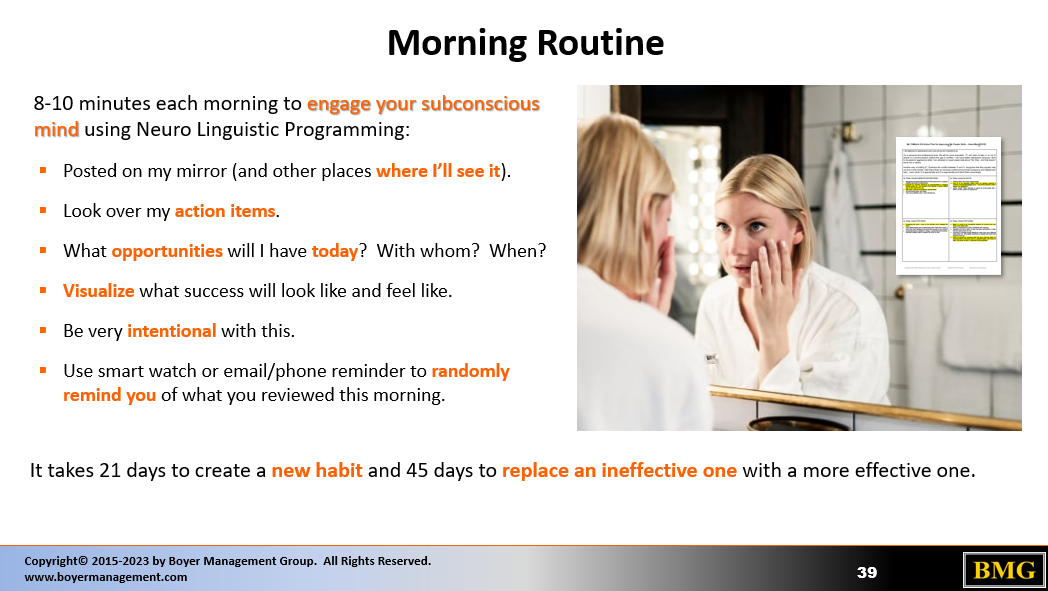
Neuro Linguistic programming of your subconscious mind incorporates reviewing in detail the highlighted behaviors you want to make into habits.
Post on your mirror and other conspicuous places. One of the best places to post your Six-Box Action Plan™ is the mirror you use each morning when you get up. Other places to post your action plan can include posting on cabinet doors, at your workstation, on the dash of your vehicle, on your refrigerator door, and other places you pass several times a day. The primary location should be on your mirror or where you go first thing after waking up. The secondary locations are places you’ll glance, and the highlighted areas will remind your brain of the actions you committed to in your morning routine. Warning: Never read your action plan when operating a vehicle.
Look over your action items. These are the six behaviors you previously highlighted. You want to read each item slowly, sounding out the words to yourself, and do so multiple times. Consistent repetition is key, so repeat as few as five times to as many as twenty. It is this process that will enable your subconscious mind to recall each action item whenever you see or think of your action plan.
Ask yourself, what opportunities will I have today to put the six behaviors to use? When? With whom? This is where you connect the behaviors you want to transform into habits to the people and situations you expect to encounter that day. Rarely can we form or change a habit in the abstract. It needs the contest of people and situations.
Visualize what success will look and feel like. It is here that you create a video in your head of you using the new behavior with someone. For example, suppose you want to learn to stop interrupting people. You check your schedule and see that later this morning you will be meeting with long-winded Frances, whom you recall you’ve interrupted before. So, create a video in your mind of her being long winded and you NOT interrupting her. What does it look like when you wait patiently with an interested and pleasant attitude? What expression is on your face? Her face? How do you feel when she finishes and says, “wow… sorry for being so long winded. I appreciate you listening,” and you didn’t interrupt her?
Be very intentional with this. Acquiring new habits takes time, stretching yourself, and being a bit uncomfortable. But you CAN DO THIS. Remind yourself why you wanted to acquire these new habits in the first place. Changing habits will require you to honor your commitment to improve and push ahead.
Use a smart watch or email/smartphone reminder to randomly remind you what you put into your subconscious in your Morning Routine. This idea comes from one of my clients, Steve A, EVP at one of the nation’s premiere claims processing companies. He got a smart watch for his birthday and the instructions said that he could program it to vibrate at random. He did, and every time he felt the buzz on his wrist, it reminded him of his action plan items for the day. This helped Steve more rapidly acquire new habits. A smartphone can do the same thing.
Your 8 Minute Evening Routine
Your evening routine is going to be a post-mortem review of your day and how you did with each of the highlighted behaviors in your Six-Box Action Plan™. You engaged your subconscious mind in the morning so that it reminded you during the day when opportunities arose to put your desired behaviors into action. You’ll do the same things to engage your subconscious in your evening debrief.
Your Evening Routine should be one of the last activities you do before you retire for the evening. Then, while you rest, your subconscious will be hard at work, helping you transform your desired behaviors into habits.
Here are some best practices associated with each of the Evening Routine activities:
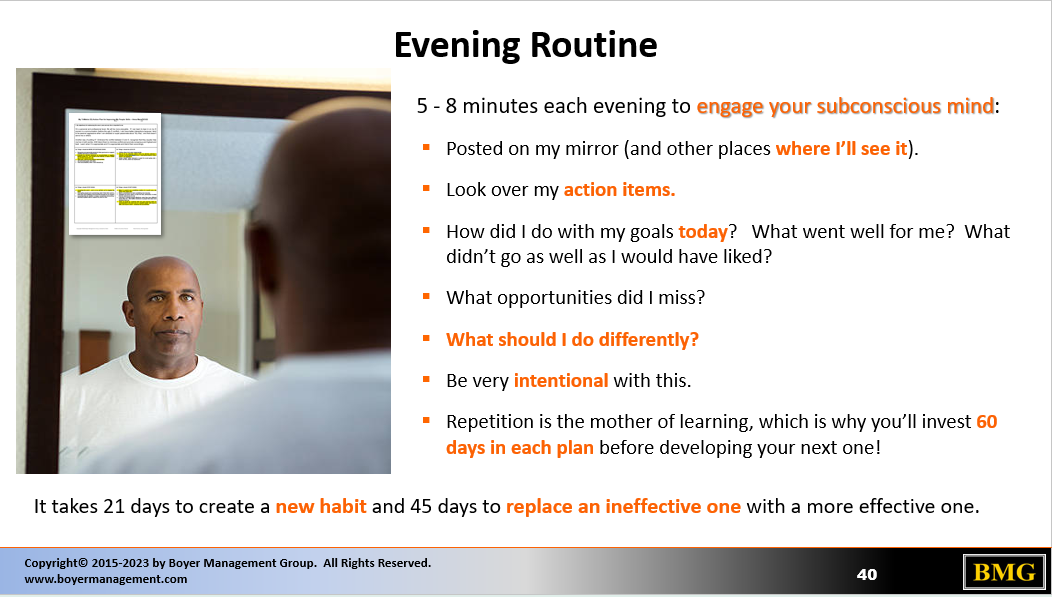
Post on your mirror and other conspicuous places and Look over your action items. These two items were covered in detail in your Morning Routine (above).
How did you do with your goals today? This is a critical self-assessment question, and a foundational step to take in your Evening Routine. It allows you to mentally recall the events of the day and play the video in your mind of what happened. Pay attention to the non-verbal cues that revealed how you and others felt as the situation unfolded. Plus, consider how the events made you and others feel as you practiced your desired new behaviors.
- What went well for you? Always start with your successes. Success begets further success. Focus on why it went well. What specifically did you do, say, think, and feel? Since behaviors are repeatable, take the time to delve into the details. AND recall how good you felt.
- What didn’t go as well as you’d have liked? It is with this question that you identify what specifically did not go as well as you intended. When you are starting out (the first two weeks of a new 60-day action plan, things WILL go wrong. What specifically could you have done better? Can you identify why it did not go well? Look for behaviors that you can correct.
What opportunities did you miss to use your new behaviors? At the start of a new action plan expect to miss opportunities. Don’t beat yourself up… everyone misses opportunities when first implementing a plan. But learn from missed opportunities so that you anticipate and see them clearly next time.
What should you do differently? Great question to ask yourself when something doesn’t work as well as you’d like. Then consider how you could approach the same situation differently. Play the video in your mind back and forth to spot points where a different approach could yield a better outcome. What specifically should you do differently? Then purpose to do this the next time an appropriate opportunity arises.
Be very intentional with this. Remind yourself why you wanted to acquire these new habits in the first place, and what mastering them will do to improve your relationships and career effectiveness. Focus on what success looks like.
Repetition is the mother of learning. With your action plan’s morning and evening routine becoming a daily habit, it won’t be long before you’ll think, “hey, I got this!” It’s normal to start thinking this after a few weeks. Remember that it takes 45 days to replace an ineffective habit with an effective one. Sixty days is truly needed to transform your behaviors into habits that you’ll do without thinking. So DO NOT cut your 60-day action plan short.
Bottom Line
The Six-Box Action Plan™ format has produced astounding results for those who have implemented it. If you commit to one full year of using this approach, then by year’s end you’ll have acquired between 24 and 36 new success habits. The change in you – how people view you – will be noticeable. You’ll feel so much better about yourself, and others will compliment you as they see your progress.
Let me ask you one last question: what is holding you back from fulfilling your potential and becoming the person you were meant to be?
About me: Since founding Boyer Management Group 28 years ago, I’ve been blessed to work with some of the world’s top employers by helping them get the most out of their talented people. Thanks to our clients, the company I founded in 1998, Boyer Management Group, was recognized by CEO Monthly Magazine in 2023, 2024, and again in 2025, awarding us their “Most Influential CEO Award” in the executive coaching field. C-Suite Insider named me its 2024 CEO of the Year for Executive Coaching. Our coaching programs produce remarkable results in compressed periods of time. Our extensive leadership development course catalog provides effective skills-building for everyone in the organization, from the new and developing leader to the seasoned C-level executive. BMG boasts one of the most extensive sales and sales management curriculums anywhere, with behavioral assessments to help develop talent. To find out more, please visit us at www.boyermanagement.com or email us at info@boyermanagement.com.


Latest Leadership Posts
Effective People Live the Goldilocks Principles Continue Reading
Don’t Be That Guy Continue Reading
How to Hire the RIGHT Sales Talent – Part 1 Continue Reading

