
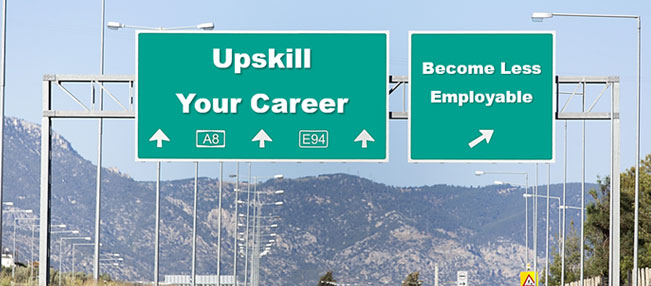
Upskill Your Career for 2026 – Part 1
Posted in Assessments & Evaluations, Case Studies, Dynamic Training News, Latest Leadership Posts, Leadership Development & Training, Performance Management, Talent Development & Training on Dec 09,2025
As you read this you may be working on New Year’s Resolutions for the year ahead. According to Pew Research, 30% of all people make at least one New Year’s Resolution, with 49% of the age group 18-29 making at least one resolution, followed by nearly a third of people 30-49 years of age. The same research reveals that six in ten people are still at it by January 31st.
As you near the end of 2025, how did you do on your 2025 New Year’s Resolutions?
About a quarter of people who make New Year’s resolutions never succeed in achieving them. It almost certainly wasn’t that they lacked the interest in making the change. It’s just that something (or someone) hijacked their resolve – and the plan to get from here to there became too burdensome. Or maybe there wasn’t an effective plan. Whatever the reason, something interfered with the resolution to get better.
Lessons from a successful coaching practice
I’ve spent my entire career helping people become more effective in what they do professionally. Ever since I hired my first employee in October 1976 I’ve experimented with tools and methods to help people achieve their objectives.
In this two-part series I’ll share some of the best practices I’ve learned along the way, practical ideas you can apply to upskill yourself or others, to make the year ahead your best year.
I like how Coursera defines upskilling: Upskilling means learning new and enhanced skills that relate to your current role. Think about it as “leveling up” your skills. Often, you’ll deepen your knowledge about your role and industry as you gain more experience.
Deciding to Upskill
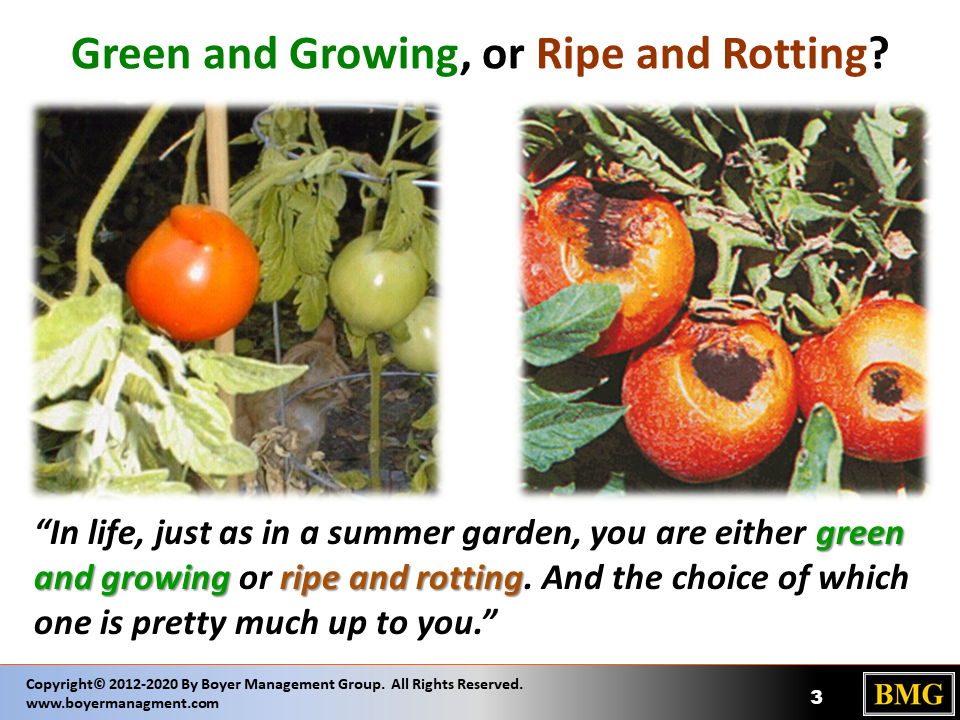
What got you here is not enough to take you into the future. I’ll never forget what my grandfather told me when I was perhaps seven or eight years old and pulling weeds in the family’s vegetable garden:
Every Journey is About Going from Here to There
Any goal or objective requires three elements, whether taking a vacation, learning to play a musical instrument, or upskilling in your profession.
- Accurately assess where you are right now (the here).
- Specifically determine where you want to be by when (the there).
- Develop and implement a plan to move from here to there (the how).
One: Begin by Assessing Where You Are Now
Here are five tools and approaches I use most often to gain an accurate current picture of where a coaching client is in their career.
- Self–assessment. Each person has some idea of his or her specific needs – what he or she wants to accomplish. It is not just about the WHAT to accomplish by WHEN, but WHY is it important to someone to achieve their WHAT. I typically interview him or her to learn as much detail as is possible. Often our discussion results in him or her gaining clarity on the WHAT and the WHEN as I want learn about both his or her objectives, plus his or her capacity and motivation to grow.
- Behavioral / motivational / EQ assessment. This tool saves hours of time at the start and enables me to fill in a lot of details to understand why someone behaves the way he or she does. We spend time together exploring the assessment results and then validate the behavioral profile during the time we work together.
- Competence / knowledge assessment. This tool allows me to measure what someone knows and understands about the best practices in a particular area, such as management/leadership disciplines, sales, or communication skills. The results allow me to measure the gap between where they are now in contrast to a set of relevant best practices.
- Supervisor / peer interviews. In addition to an individual’s observations about themselves, the people with whom they work most closely can shed some light on both the individual’s working environment and the personal and workplace behaviors they observe.
- Observation. After decades of helping people develop to their potential I’ve been able to know what to look for that can provide the clues to helping someone improve.
Two: Prioritize Where You Want to Upskill
Each of us has a distinct set of priorities dictated by our current work objectives and circumstances, our supervisors, the important people in our life, and our life situation. Because people cannot work on too many things at once, we must identify the relative importance of the skill areas in which to upskill.
I suggest identifying the top three to five areas that if improved, would lead to the greatest growth and success. These areas don’t remain static, so you’ll want to periodically reassess and re-prioritize.
Three: Identify Best Practices Compared to Your Current Knowledge and Measure the Gap
There are a number of reliable sources that can be used to set forth the best practices in any given area, from best-practices authors, trainers, practitioners, and experts. Consult those whose results are proven in actual field use. Avoid the trendy stuff and the “three-step cures for whatever ails you” solutions. Look for resources which have a strong record of success in your business area. Choose the practical over the theoretical.
Many of the assessments I use provide specific actions that can be taken that are current and emerging best practices. Additionally, there are many exceptional business writers and organizations that publish best-practices guidance, so bookmark their sites and collect content that you’d like to learn.
You’ve completed the first half of your 2026 Upskilling Plan with three more key steps to take, which we’ll explore in detail in Part 2 of Upskill Your Career for 2026. Until next time, remember it is your choice to be green and growing!
About me: Since founding Boyer Management Group 26 years ago, I’ve been blessed to work with some of the world’s top employers by helping them get the most out of their talented people. Thanks to our clients, the company I founded in 1998, Boyer Management Group, was recognized by CEO Monthly Magazine in 2023 and again in 2024, awarding us their “Most Influential CEO Award” in the executive coaching field. Our coaching programs produce remarkable results in compressed periods of time. Our extensive leadership development course catalog provides effective skills-building for everyone in the organization, from the new and developing leader to the seasoned C-level executive. BMG boasts one of the most extensive sales and sales management curriculums anywhere, with behavioral assessments to help develop talent. To find out more, please visit us at www.boyermanagement.com, email us at info@boyermanagement.com, or call us at 215-942-0982.


Latest Leadership Posts
Effective People Live the Goldilocks Principles Continue Reading
Don’t Be That Guy Continue Reading
How to Hire the RIGHT Sales Talent – Part 1 Continue Reading

