
Upskill Your Career for 2026 – Part 2
Posted in Case Studies, Dynamic Training News, Latest Leadership Posts, Leadership Development & Training, Performance Management, Talent Development & Training on Dec 23,2025
You can, in fact, improve your skills in any area you desire. It is not particularly hard. You simply need to do the right things at the right time, and you’ll be on your way from where you are to where you want to be. Forty years of coaching and training people to help them reach their potential has taught me these important lessons that I now want to share with you.
The first half of the journey – Part 1
In Part 1 we investigated the first three steps across the chasm that separates you from where you want to be. You can read Part 1 here. Here’s a quick synopsis of what we learned:
- Deciding to Upskill. What got you here won’t be enough to take you into the future. To remain relevant and improve your employability, you’ll need to intentionally upskill for the year ahead.
- Every Journey is About Going from Here to There. You’ll need to adequately assess where here is for you, and where you want to be by the end of 2026, then figure out how to get there.
- One: Begin by Assessing Where You Are Now. We looked at five proven tools to help you do this.
- Two: Prioritize Where You Want to Upskill. Prioritizing helps you identify the most important things that if improved, will make the greatest positive impact on you and your life.
- Three: Identify Best Practices Compared to Your Knowledge and Measure the Gap. Once you’ve selected the area in which you want to improve, you’ll need to learn about the current and emerging best practices associated with each area.
Here is your path forward to move from where you are to where you want to be:
Four: Build a Four-Quadrant Action Plan
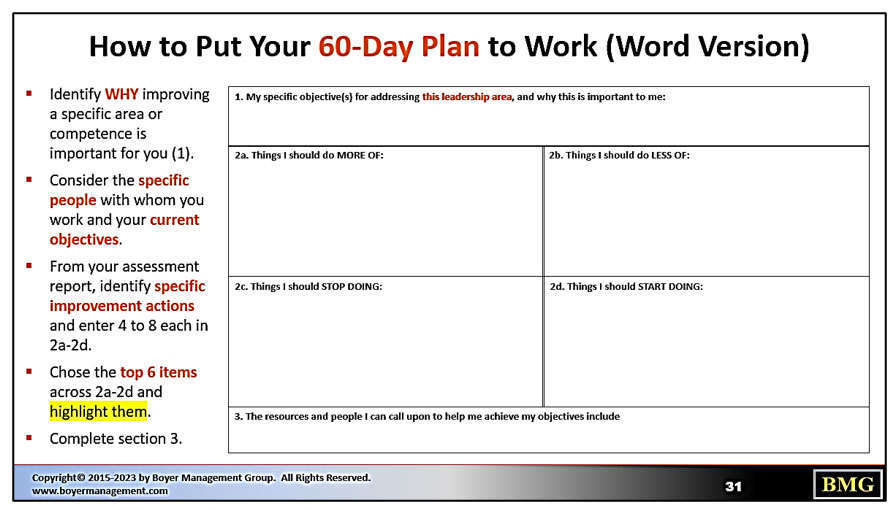
Over the years I’ve found the most effective plans are often the straightforward and practical ones. A planning template is just that, a template that makes it easy to organize the actions you want to or need to take in order to move from where you are to where you want to be. I favor the more/less/stop/start format, though there are others. I ask my clients to create their first draft, and then we refine it together over time.
- My Specific Objective & Why It is Important to Me – this is usually the first item on the plan that gets created. It is a statement of reasons why improving in this specific area is important to you.
- Do More Of / Continue quadrant – list the actions/approaches you need to do more of, selected from the set of best practices associated with your improvement area. This quadrant is often the one with the largest list of action items.
- Do Less Of quadrant – list the actions/approaches that you need to do less of and the habits and approaches that need to be diminished.
- Stop quadrant – list the actions/approaches that you need stop doing. These are easy to identify when you compare your own current practices with the set of best practices in the improvement area.
- Start quadrant – list the actions/approaches that you need to start doing. Again, easy to identify when you compare your current practices to the improvement area’s best practices.
- Resources – identify the people and other resources that can help you. Include an accountability partner and/or coach. And the best-practices sources.
Five: Execute your plan.
Here are several best practices associated with the successful execution of your plan:
- Daily review. If you’re a morning person, review your plan in the morning. If you’re an evening person, review it late in the day. Either way, be intentional about it and schedule this daily event on your calendar with a notification to remind you.
- What to look for. It’s unlikely that you had an opportunity to take every action you listed on your plan on any one day. Rather, there were opportunities to do more of, less of, stop doing, and start doing certain actions during the preceding workday. And there will be opportunities to do more of, less of, stop doing, and start doing certain actions during the day ahead. By reviewing the list every day you can choose which actions to take as part of your normal workflow.
- You may be someone who likes to post copies of your action plan on the mirror (and see it morning and night), or somewhere in your car, or at your desk. Multiple impressions of your plan serve both as reminders and a reinforcement to take the actions you listed. So keep your plan visible where you’ll see it.
- According to experts it takes 21 days to create new habits. And between 45 and 60 days to replace ineffective habits with effective ones. So your action plan should be in place for at least 60 days for it to help you make permanent changes to improve.
Six: Review your plan with a coach or accountability partner
While it is possible to get better at anything without a coach or accountability partner, most people lack the discipline and expert guidance to achieve the elevated levels of quality and quantity change that a coach or accountability partner will provide. Today, professional coaching is recognized as one of the best investments organizations can make in their people, and people can make in themselves.
- Coach or accountability partner. Accountability partners are people you trust to give you honest feedback, and who agree to come along side you to keep you on plan. Coaches typically bring objectivity, experience, education, practical training, and sometimes certification to your development. The best coaches and accountability partners have practical experience in the areas in your identified improvement areas.
- Internal or external coach. Internal coaches are typically found in the largest organization while external coaches have their own practices or are part of an organization that offers coaching. Look for a coach with broad experience and a record of success in the roles you are in or aspire to.
- Chemistry, Trust, & Confidentiality. A coaching or accountability relationship will not work unless there is good chemistry between the two of you. And since you’ll be sharing personal and confidential matters make sure this person is someone with a history of trustworthiness and integrity. What do his or her clients say about this?
- Frequency. Coaches/accountability partners and clients work out a mutually agreeable meeting schedule. I usually meet with new clients every other week for the first few months, and then move our sessions out to every three or four weeks as the situation dictates. Look for a coach to have flexibility in working with your schedule. A coach should be accessible in between scheduled sessions to take a call, meet, or respond to your email or text.
- Meeting logistics. Technology has made it possible to meet face-to-face using a virtual meeting, so your coach can be from anywhere. I have coached clients across ten time zones and distance does not reduce the effectiveness of our meetings.
- Challenge and stretch. A good coach or accountability partner will challenge you and stretch you. Just like any other type of improvement there will be a little pain…no pain, no gain! Assignments between sessions should be relevant to your job and situation. Good coaches ask tough questions. They are honest in telling you the naked truth, which sometimes you might not want to hear. But stick with it and you’ll emerge all the better.
- Google articles about selecting and working with a coach. Here’s one you might find helpful to guide you through critical selection criteria.
Bottom Line
So there you have it. Six steps that will help you get better at anything. Anything. All it takes is the right approach and a plan to move from here to there and the desire and commitment to do it.
About me: Since founding Boyer Management Group 26 years ago, I’ve been blessed to work with some of the world’s top employers by helping them get the most out of their talented people. Thanks to our clients, the company I founded in 1998, Boyer Management Group, was recognized by CEO Monthly Magazine in 2023 and again in 2024, awarding us their “Most Influential CEO Award” in the executive coaching field. Our coaching programs produce remarkable results in compressed periods of time. Our extensive leadership development course catalog provides effective skills-building for everyone in the organization, from the new and developing leader to the seasoned C-level executive. BMG boasts one of the most extensive sales and sales management curriculums anywhere, with behavioral assessments to help develop talent. To find out more, please visit us at www.boyermanagement.com, email us at info@boyermanagement.com, or call us at 215-942-0982.


Latest Leadership Posts
Effective People Live the Goldilocks Principles Continue Reading
Don’t Be That Guy Continue Reading
How to Hire the RIGHT Sales Talent – Part 1 Continue Reading

