
How to Raise Your Own Emotional Intelligence, Part 1
Posted in Dynamic Training News, Latest Leadership Posts, Leadership Development & Training, Performance Management, Talent Development & Training, Team Building & Alignment on Nov 24,2026
By now, the massive impact of emotional intelligence on one’s career and personal effectiveness is the worst kept secret of the of the 21st century:
- Daniel Goleman in his 1995 bestseller Emotional Intelligence pointed out emotional intelligence matters more than IQ in determining one’s effectiveness.
- In a further study, Dr, Alan Zimmerman determined that the impact EQ has on one’s success is so profound that “emotional intelligence has become the best predictor of success.”
- Here’s an amazing finding about how EQ relates to earnings: “The link between EQ and earnings is so direct that every point increase in EQ adds $1,300 to an annual salary.” – Dr. Travis Bradberry, Emotional Intelligence 2.0
Regardless of profession, those with the “people smarts” seem to populate the express lanes of upward career movement. You know this is true because you can see it in your own career and the careers of the people with whom you work.
Don’t Try to Guess Your Own Emotional Intelligence
A common mistake people make is attempting to evaluate their own emotional intelligence levels. Why is this a mistake? Those who are relatively low in emotional intelligence routinely self-assess themselves much higher than they are. And those who are high in EQ may regularly underestimate their own EQ.
Why does this happen? This article from The Decision Lab explains it well. “The Dunning-Kruger effect occurs when a person’s lack of knowledge and skill in a certain area causes them to overestimate their own competence. By contrast, this effect also drives those who excel in a given area to think the task is simple for everyone, leading them to underestimate their abilities.”
I believe an excellent solution to assessing your own emotional intelligence lies in using a well-researched, validated, correlated, and reliability-tested EQ assessment. A multi-year search for such an instrument brought me to my go-to assessment processor, TTI, and their Emotional Quotient™ 3 assessment. I have administered nearly a thousand EQ3 assessments over the past decade and coached abut the same number of individuals to help them raise their EQ.
What Exactly is Emotional Intelligence?
Travis Bradberry, in his aforementioned book, Emotional Intelligence 2.0, defines emotional intelligence as “your ability to recognize and understand emotions in yourself and others, and your ability to use this awareness to manage your behavior and relationships.” We use our EQ to process everything we encounter in life.
There are two parts to EQ, the intrapersonal (shown in red) and the interpersonal (shown in blue).
Intrapersonal is what goes on inside each person:
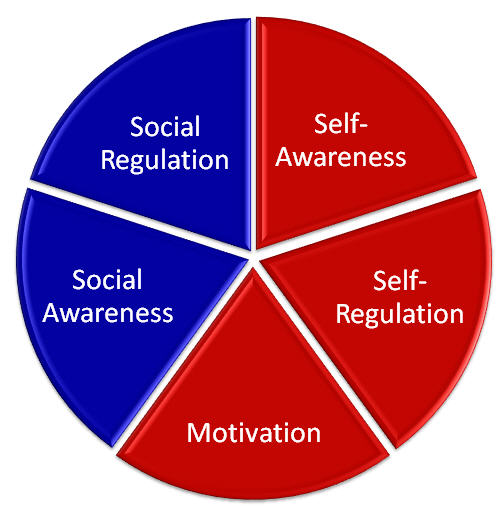
- Self-Awareness: both recognizing and understanding one’s own moods, emotions, and triggers, as well as the way they impact others.
- Self-Regulation: one’s ability to control and redirect his or her own disruptive impulses, plus the ability to carefully consider before acting.
- Motivation: being aware of what specifically motivates an individual and how this differs from other people.
Interpersonal is what goes on between someone and others:
- Social Awareness: recognizing the emotional makeup of others and how his or her words and actions impact them.
- Social Regulation: one’s ability to influence the emotional clarity of others by effectively building both relationships and people networks.
EQ is Learnable, IQ is Not
Many people are surprised to discover that they have been learning emotional intelligence all their lives. Here’s how. Friends and family have made suggestions to you from time to time that impacted the way you interact with others. Your supervisors have given you feedback on performance evaluations that have led you to change your behavior and approach. You’ve observed people with exceptional people skills and have adopted some of their habits and practices.
In other words, your own university of life experience has led to growth and improvement in EQ as you have aged. Sometimes what we call wisdom is actually applied emotional intelligence.
According to research from UC Berkely, people generally reach their peak emotional intelligence levels as they enter their 60’s. It is typically a slow build without an intentional plan to raise EQ.
Use a Reliable EQ Assessment – the Case of Thomas Smith
In about 10-12 minutes of full-focused time completing his EQ3 assessment, this report was created for one of my coaching clients, John Smith:
His report measured all five EQ areas and rendered a score to show Tom how he compared to the approximately 8 million people who have completed this instrument to date.
Tom’s score is shown in the colored bar and ball using a 100-point scale.
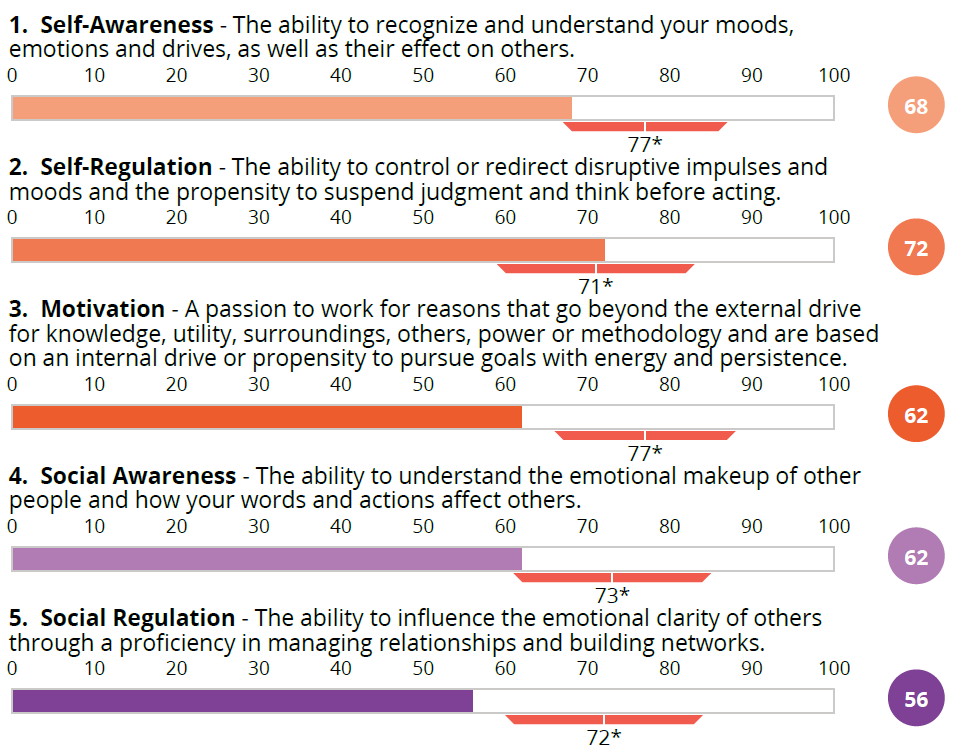
The asterisked number (71* in area 2, Self-Regulation) is the mean score, and the red boat shape immediately above the 71* shows how 68 percent of the 8 million respondents scored in that area.
Scores appreciably lower than the mean score indicates that Tom is specifically deficient in area 3, Motivation and area 5, Social Regulation.
Additionally, Tom is low (but still in the mainstream range) in area 1, Self-Awareness, and area 4, Social Awareness.
He is solid in Self-Regulation, area 2, where he is one point above the mean.
In Part 2 of this article, we will see how Tom Smith raised his EQ in one year to be in the upper 10% of responders in each of the five areas. It wasn’t magic; it was challenging work. And I’ll show you how he did it.
Bottom Line
Emotional intelligence is perhaps the most effective predictor of one’s professional and personal success. EQ can be measured using a proper instrument like the EQ3. Most importantly, EQ is both learnable and developable so that virtually anyone can reap the relationship, career, and financial benefits that higher emotional intelligence brings.
This article is based on principles taught in Boyer Management Group’s acclaimed leadership development series, Leading Through People™ LTP18 – Leading More Effectively With Emotional Intelligence and the sales development series, B2B Sales Essentials™ B2BSE15 – Selling With Emotional Intelligence.
About me: Since founding Boyer Management Group 28 years ago, I’ve been blessed to work with some of the world’s top employers by helping them get the most out of their talented people. Thanks to our clients, the company I founded in 1998, Boyer Management Group, was recognized by CEO Monthly Magazine in 2023, 2024, and again in 2025, awarding us their “Most Influential CEO Award” in the executive coaching field. C-Suite Insider named me its 2024 CEO of the Year for Executive Coaching. Our coaching programs produce remarkable results in compressed periods of time. Our extensive leadership development course catalog provides effective skills-building for everyone in the organization, from the new and developing leader to the seasoned C-level executive. BMG boasts one of the most extensive sales and sales management curriculums anywhere, with behavioral assessments to help develop talent. To find out more, please visit us at www.boyermanagement.com or email us at info@boyermanagement.com.


Latest Leadership Posts
How to Raise Your Own Emotional Intelligence, Part 1 Continue Reading
Ten Commandment for Keeping Great People Continue Reading
Effective People Live the Goldilocks Principles Continue Reading

